The Fool’s Journey: Part Two
Welcome back to the looking glass. This week, we continue our journey through the Major Arcana, but the energy has shifted. While Part One: The Foundation was about navigating external nonsense with a flamingo in hand, Phase 2 (Cards 8–14) turns the path inward.
These next chapters aren't about the eccentric characters we meet; they are the vital, often difficult lessons we must learn within ourselves. We are moving from simply doing the work to becoming the person capable of leading it. Through the Tarot in Wonderland deck, these images become more than just symbols - they become a tangible story of resilience, stillness, and the courage to let go of what we have outgrown.
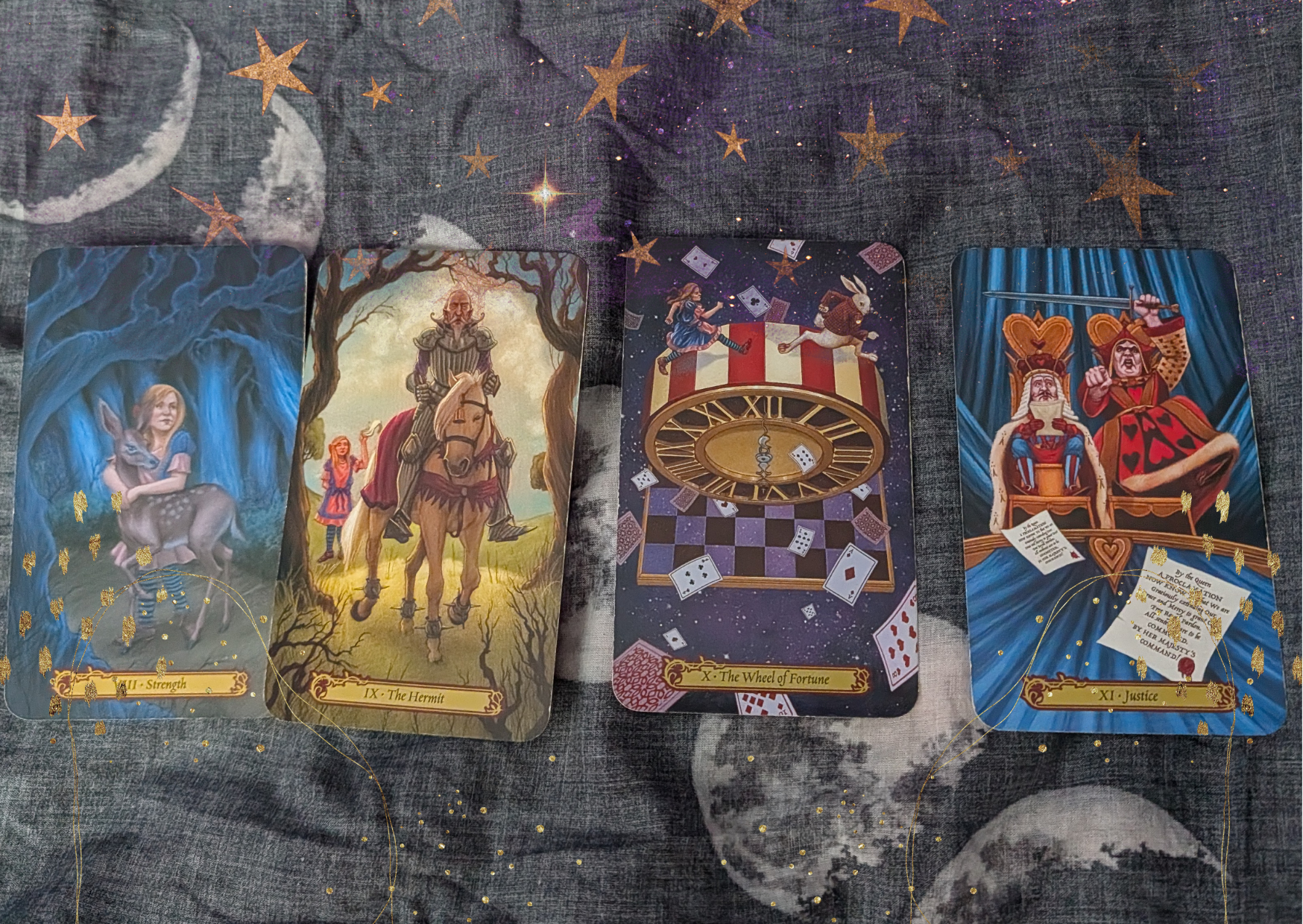
VIII. Strength
The Traditional Image: In the Rider-Waite deck, we see a woman in white standing calmly over a lion, gently but firmly holding its jaws. This isn't a battle of muscle; it’s the ultimate image of spiritual power. The lion represents our raw passions, our animal instincts, and the fiery parts of our ego that want to roar or lash out. She doesn't use a whip or a cage to subdue him; she uses her serene, steady presence. It tells us that true strength isn't about dominance or aggression, but the courage to sit with our own internal turmoil without being consumed by it.
The Alice Image: We see Alice in the dark woods with her arms wrapped around a fawn. In Wonderland, the "Wood where things have no name" is a place where identity dissolves and the labels we use to classify the world disappear. Alice knows she must navigate these woods to reach the next square on the chessboard and achieve her goal of becoming Queen, but instead of fighting the disorientation, she moves through it in perfect, gentle harmony with a wild creature. This scene matters because it shows that when we strip away the "names" and the noise, we find a quiet resilience. It’s the strength found in vulnerability and the refusal to let fear dictate our steps.
The Meaning: This card is a reminder that the path to our goals is rarely a sprint; it’s an exercise in patience and empathy. To be truly strong, we must first understand ourselves and accept our own shadows, which in turn allows us to treat others with the same grace. When we are consistent in our actions—even when we are afraid or uncertain—the results will inevitably follow. It’s a lesson in not lashing out just because we feel threatened, but choosing to be better than our base reactions.
The Strategic Insight: In the world of business, it’s easy to react with a "roar" when things go wrong. However, your true power lies in your ability to remain composed under pressure. This is a signal to consult your innerwisdom and lead with empathy rather than ego. When you master your internal reactions, you become a leader others naturally trust and follow.
IX. The Hermit
The Traditional Image: We see an old, bearded man standing alone in the snowy wilderness, holding nothing but a staff and a lantern. The staff is his self-support—it represents the internal strength required to stand on your own two feet without leaning on the world. The lantern contains a six-pointed star, a symbol of the divine light within that guides our path even when the external world is dark. He isn’t hiding; he is seeking the silence required for discretion and careful planning. He knows that you cannot find your own truth if you are constantly listening to the voices of others.
The Alice Image: The Hermit is beautifully represented by the White Knight as he rides off on his horse, finally leaving Alice to continue her journey toward becoming Queen. He is the kindest, most eccentric character Alice meets, and though he repeatedly falls from his horse, his composure never breaks. When Alice asks how he remains so calm, he offers the quintessential Hermit philosophy: What does it matter where my body happens to be? My mind continues working all the same... This scene marks the moment where Alice must step into her own power. The Knight’s departure shows us that there comes a point where we must leave our guides behind and trust the wisdom we have integrated.
The Meaning: Wouldn't it be nice if we could just escape from it all—the distractions of life and the heavy weight of our responsibilities—and simply have time alone with our thoughts? The Hermit tells us that it is time to do exactly that to find our soul's path. We need solitude to integrate our experiences across mind, body, and soul. This card isn't about being lonely; it’s about having the courage to be alone, which many find terrifying. It’s a time to share your knowledge with those behind you, but primarily a signal that you need to rest and see how the pieces of your own puzzle finally fit together.
The Strategic Insight: Constant doing can actually be a distraction from being. Your greatest competitive advantage is the clarity that only comes from stepping back. Use this time to quiet the noise and review your original why. True innovation doesn't happen in the chaos; it happens in the quiet moments where you have the courage to listen to your own internal compass.
X. The Wheel of Fortune
The Traditional Image: In the Rider-Waite deck, the Wheel appears suspended between clouds in a brilliant blue sky. This openness symbolises hope, clarity, and a major breakthrough on one’s spiritual path. We have reached the literal halfway mark of the Major Arcana. At this junction, we move away from the external world and its various influences, turning our focus instead toward the internal shifts of the inner world. The wheel reminds us that while the world spins, we must find the stillness within the blue sky of our own consciousness.
The Alice Image: Alice and the White Rabbit are shown running atop a giant, striped clock face that acts as the wheel. They are caught in a perpetual race across a floating chessboard in space, surrounded by a whirlwind of tumbling playing cards and pocket watches. The clock hands are frozen, suggesting that while their effort is immense, the cycle itself governs their progress. It perfectly captures the paradox of the Red Queen’s Race; Alice finds that in this surreal landscape, she actually has to run away from the Queen in order to catch up with her.
The Meaning: The Wheel is a reminder that life is in a constant state of flux and that we are currently at a pivotal turning point. It signifies that things are moving—perhaps even spinning—often governed by the laws of destiny or karma. This card tells us that while we cannot control the spinning of the wheel, we can control our reaction to it. It is a call to recognise the patterns in your life and accept that nothing stays the same forever. It is the point where you stop being a passenger to fate and start understanding the cycle.
The Strategic Insight: In business, the Red Queen’s Race is a common trap—putting in immense effort just to maintain the status quo. You demonstrate resilience by staying centred while the wheel spins. This is your signal to lean into your intuition to discern if you are running in circles or if a breakthrough is imminent. Sometimes, the strategy is to stop running toward the goal and instead run away from the old way of doing things to finally catch up with your true purpose.
XI. Justice
The Traditional Image: Justice sits on her stone throne, positioned between two pillars that represent the balance of the universe. In her right hand, she holds a double-edged sword upright—a symbol that the truth is sharp and every decision carries a consequence. In her left, she holds the golden scales, perfectly level, showing that our intuition must be weighed against logic. Unlike many worldly depictions of Blind Justice, the Tarot figure is wide-eyed; she sees everything with total clarity, unswayed by emotion or deception.
The Alice Image: We are at the Knave of Hearts’ trial at the end of the first book, a scene of absolute chaotic energy. The Queen of Hearts is the embodiment of raw passion and ego, making snap judgements based on the slightest perceived insult and screaming "Off with her head!" at every turn. In stark contrast, the King offers a kinder, more merciful approach. He is the one who quietly whispers "You are all pardoned" after the croquet game and attempts to bring a sense of common sense and order to the nonsensical trial. This duality represents the internal struggle to balance our reactive emotions with our rational, fair-minded truth.
The Meaning: Justice is about the law of cause and effect—the simple reality that our current circumstances are the result of our previous actions. It suggests that a verdict is imminent, and while it may feel cold, it is fundamentally fair. This card is not interested in your excuses or your intentions; it deals only in the facts. It is a call to honesty and integrity, stripping away the stories we tell ourselves to look at the balanced scales of our lives. If you have acted with honour, you have nothing to fear.
The Strategic Insight: For the soul-led entrepreneur, Justice is the card of ethics, contracts, and Radical Honesty. It is a reminder to practice total accountability for every outcome in your business, even the ones that didn't go to plan. Ensure your professional dealings align with your deepest personal values. In a world of Queen of Hearts noise, your commitment to truth and fair exchange is your greatest protection.
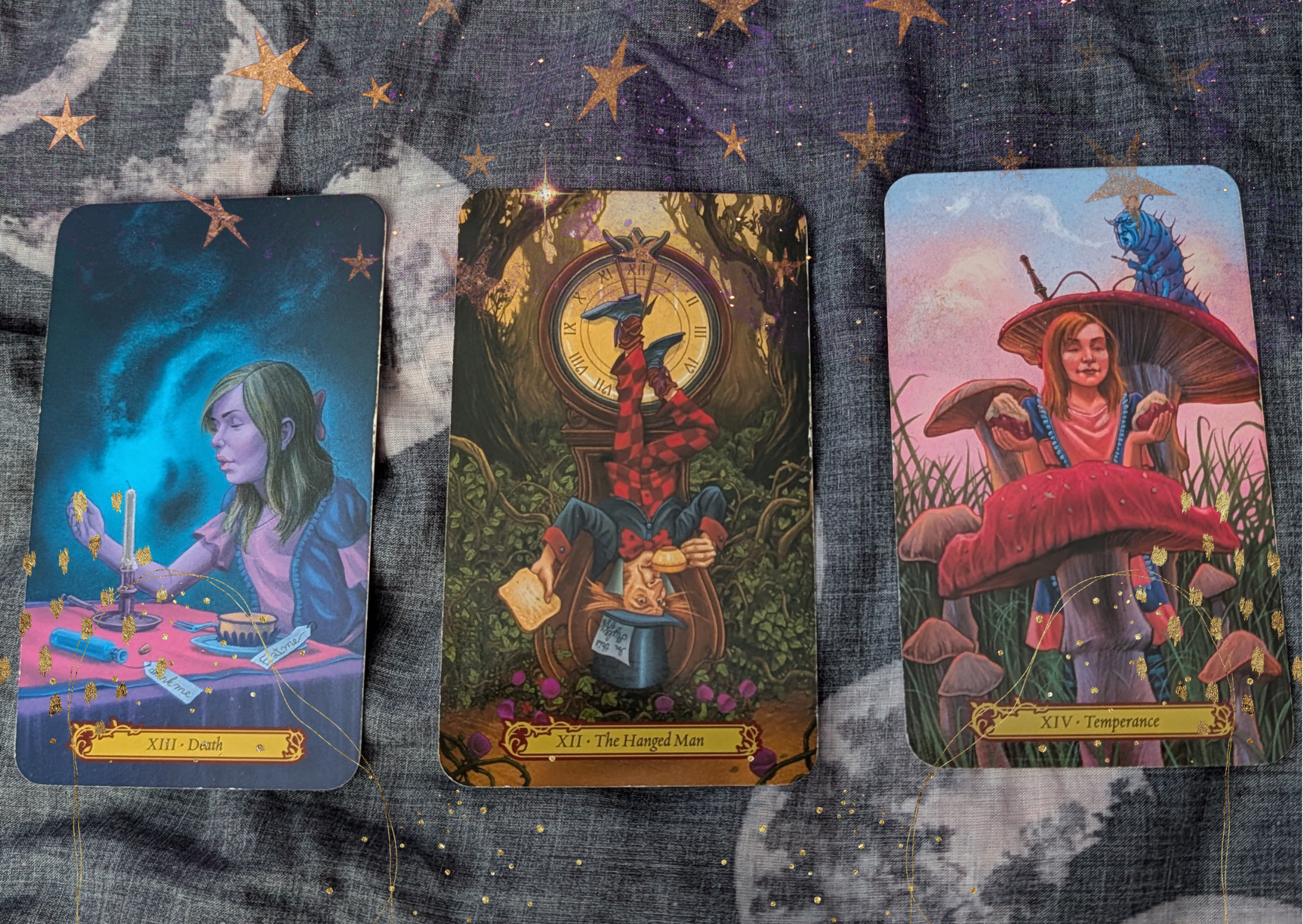
XII. The Hanged Man
The Traditional Image: We see a man suspended upside down from a T-shaped cross made of living, budding wood. His right leg is bound, yet his left leg is tucked behind it with ease, and his arms are folded behind his back. Most importantly, he isn’t struggling; he has a glowing halo around his head. This isn’t a scene of punishment, but of voluntary surrender. He has chosen to hang here to see the world from a completely different perspective, sacrificing his movement to gain a higher level of enlightenment.
The Alice Image: In the Tarot in Wonderland deck, the Mad Hatter is suspended upside down from a giant grandfather clock. Ever since the Queen of Hearts accused him of murdering time during his song, Time has refused to move for him, leaving him stuck at an eternal tea party. This matters because it illustrates the heavy weight of being stuck in a cycle not of your making. Despite this, the Hatter is perfectly composed, holding his teacup and bread. He has stopped fighting the clock and has surrendered to the stillness, finding a way to exist within the suspension rather than exhausting himself by struggling against it.
The Meaning: The Hanged Man represents a period of necessary pause and surrender. It tells us that sometimes, the only way to move forward is to stop moving entirely. It is the card of letting go and sacrifice—giving up the need to control the outcome in order to see a deeper truth. When you feel stuck or in limbo, this card suggests that the suspension is actually a gift. It is an invitation to look at your situation from a new, unique approach that only becomes visible when you stop trying to force your own will upon a world that has gone momentarily still.
The Strategic Insight: In business, there are times when no amount of hustle or strategy will work. This is a call to surrender your current plan and trust in divine timing. You show immense emotional maturity by remaining calm and composed when things feel upside down or stalled. Instead of panic-working, use this time to integrate your mind, body, and soul. Often, the breakthrough you need arrives the moment you stop trying to force it.
XIII. Death
The Traditional Image: The figure of the Grim Reaper is an eternally understood archetype and an immutable part of our existence. Whether he appears as a hooded figure wielding a scythe or an armoured skeleton upon a pale horse, he serves as a permanent reminder of our human frailty. He is the bringer of necessary change, representing the absolute, impartial transition that clears the ground for a fresh beginning. This isn't an end to be feared, but a recognition that for life to evolve, the old structures must eventually yield.
The Alice Image: Alice stands before the "Drink Me" bottle, contemplating a fundamental transformation. As she wonders how small she might become, she is struck by a deeper, more existential curiosity: she wonders what the flame of a candle looks like once it has been blown out. This matters because the light of that candle represents the experiences we carry with us; they are the filters through which we view our reality. When the candle is extinguished, we are plunged into the dark, left to exist only with our raw hopes and fears. It is in this void that our eyes must adjust, allowing us to see the world—and ourselves—in a completely different light.
The Meaning: Death is the card of profound transition and the shedding of the old. It rarely signifies a physical end, but rather the conclusion of a major chapter or an aspect of the ego that no longer serves your soul’s path. It is a reminder that resistance only prolongs the darkness. By allowing the candle of your past experiences to go out, you create the space for a new vision to emerge. It is the courage to sit in the dark until you find the strength to see things as they truly are.
The Strategic Insight: In business, this is the Pivot. It is the moment you must kill off a project, a brand identity, or a way of working that has become stagnant. You show visionary leadership by your willingness to walk away from what is comfortable in favour of what is true. Listen to your gut instinct to identify what you are outgrowing. Do not fear the temporary emptiness of this phase; it is the necessary fertile ground for your next big breakthrough.
XIV. Temperance
The Traditional Image: An angel stands with one foot firmly on a rock, representing the present and the conscious mind, while the other is dipped into a pool of water, symbolising the past, our emotions, and the unconscious. This is the art of grounding oneself in the "now" while remaining connected to the depths of our experience. The angel carefully moderates the flow of water between two golden cups, creating a harmonious and purposeful stream. Behind them, a path winds toward a distant mountain range where a rising sun glows on the horizon—a symbol of a potential future and the new perspective that awaits once balance is achieved.
The Alice Image: Alice stands in a vast field of mushrooms, holding a piece of the magical mushroom in each of her hands. Above her, the Blue Caterpillar sits on his own mushroom, wreathed in smoke and watching her with absolute, detached calm. This scene matters because it represents the delicate work of internal adjustment. Alice has learned that she cannot simply eat blindly; she must carefully test and taste the two sides—one to grow, one to shrink—to find the exact proportions required to navigate the world. It is the moment where she stops reacting to her environment and begins to consciously regulate her own state of being.
The Meaning: At its core, Temperance is about being in total control of yourself. It is the ability to manage the flow between your conscious thoughts and your deep-seated emotions so that neither overwhelms the other. After the shedding of the Death card, this is where you find your equilibrium. It suggests that by avoiding extremes and practising self-restraint, you can integrate your past and present into a cohesive whole. It is a reminder that you are the moderator of your own energy, carefully pouring your focus into what serves your progress toward that new horizon.
The Strategic Insight: For the soul-led entrepreneur, Temperance is a call for test and taste rather than rushing to market. You demonstrate integrity and poise by your ability to remain in control of your reactions, even when external pressures are high. Find the right balance between the practical rock of your business and the emotional flow of your passion. When you find your perfect balance, you move through the world with the calm authority of someone who knows exactly who they are.
The Quiet After the Storm
Phase 2 is where the real evolution happens—away from the crowd and deep within the soul. We’ve moved from the quiet lantern of the Hermit to the "ego-death" of the candle flame, finally finding the balance of Temperance. These cards have taught us that true authority is a state of being we cultivate when we finally take control of our own internal narrative. You are no longer just a piece on the board; you are starting to understand how the game is played.
Mercury Retrograde Special Offer
Are you feeling caught in a Red Queen’s Race or waiting for your eyes to adjust after a major transition? With Mercury currently in retrograde, it is the perfect time to review, reflect, and realign before the wheel turns again.
To help you find your footing, I am still offering my Mercury Retrograde Tarot Readings at half price until the 9th of April.
If you are ready to stop running in circles and start seeing through the mist, let’s find your path to clarity together.